Threat and Vulnerability Management (TVM) is a proactive cybersecurity discipline that integrates continuous asset discovery, threat intelligence, and risk-based prioritization to identify and mitigate exposures. Unlike traditional vulnerability assessment, which focuses solely on scanning for CVEs, TVM uses context, including exploitability (EPSS) and asset criticality, to determine which risks pose an immediate threat to the organization.
What is Threat and Vulnerability Management (TVM)?
Managing vulnerabilities is no longer about generating a longer list of bugs; it is about reducing business risk. Traditional scanning provides a snapshot of "potential" problems, often overwhelming security teams with thousands of "Critical" findings that have no active exploit code.
Modern TVM shifts the focus. It does not just ask "Is this vulnerable?" It asks "Will this compromise us?" By combining continuous visibility of assets with real-time threat intelligence, security leaders can move from a reactive "patch everything" mentality to a strategic "patch what matters" approach. This distinction is necessary for maintaining a holistic posture in an environment where the attack surface changes daily.
Why is Traditional Vulnerability Scanning Failing?
Most security programs fail the "3 AM Test": if a major zero-day hits at 3 AM, can you confidently tell the Board your exposure status? For organizations relying on legacy scanners, the answer is usually "no."
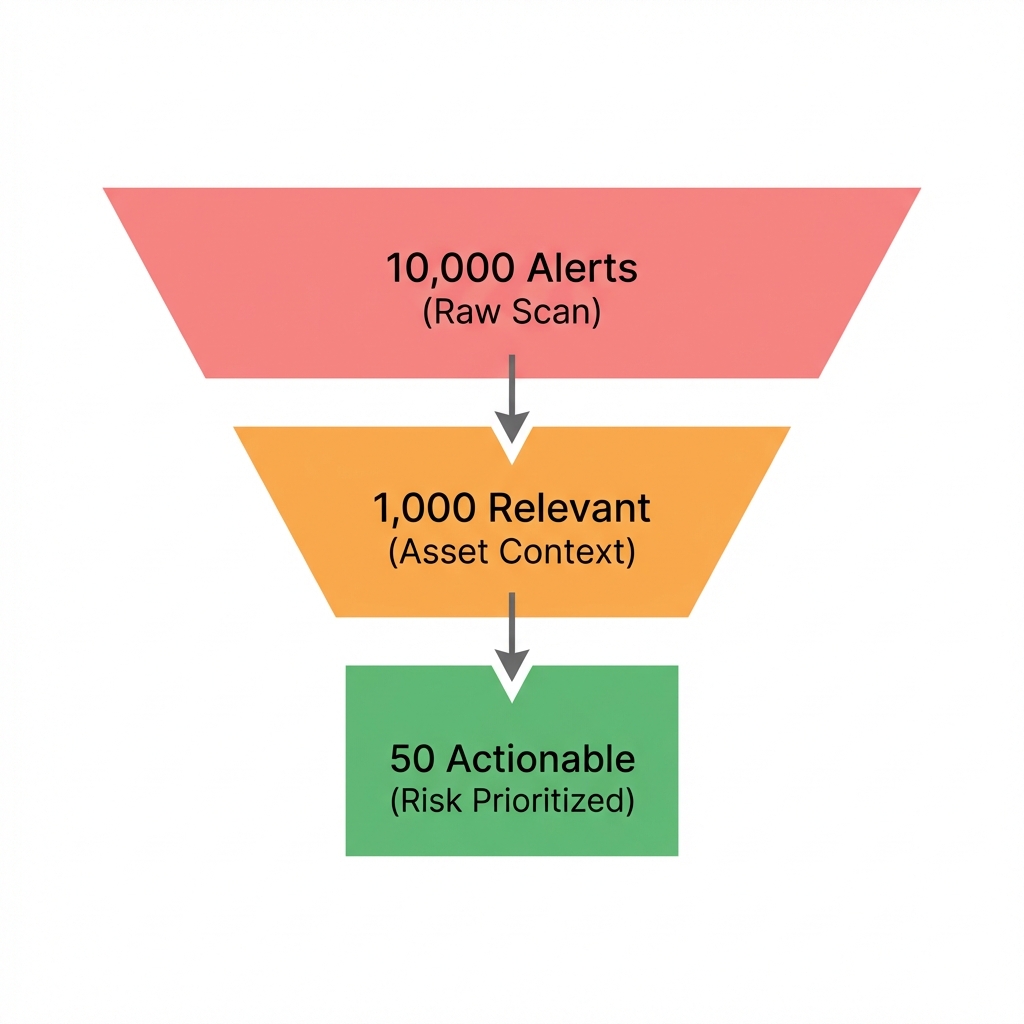
The core failure is the volume problem. Modern infrastructure generates vulnerabilities faster than human teams can remediate them. A standard scan might return 10,000 vulnerabilities. If your team can patch 50 a week, you are mathematically guaranteed to fall behind.
Legacy tools compound this issue by lacking context. They flag low-risk issues on test servers with the same severity as high-risk issues on production databases. Without a single source of truth, teams drown in spreadsheet exports, chasing "Criticals" that pose no real danger while missing the lower-scored CVEs that attackers are actively chaining together.
How Does a Modern TVM Lifecycle Work?
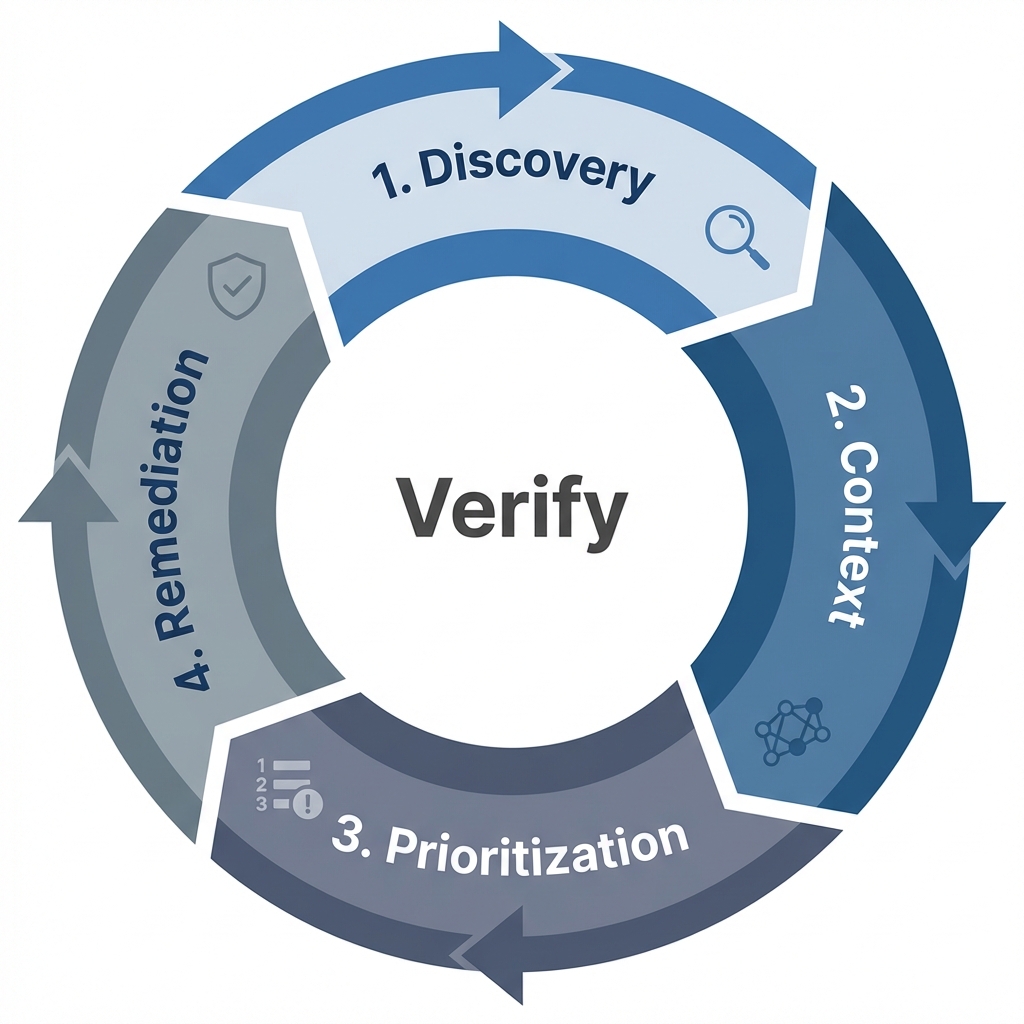
A functional TVM program operates as a cycle, not a linear checklist. It moves continuously through four stages:
- Discovery (EASM): You cannot protect what you cannot see. Automated discovery identifies all assets across on-prem, cloud, and shadow IT environments. This eliminates the "unknown asset" risk.
- Context (Threat Intel): Raw CVE data is enriched with threat intelligence. Is there a proof-of-concept exploit? Is a nation-state actor using this?
- Prioritization (Risk): Assets are scored based on business criticality. A vulnerability on an external-facing payment gateway gets priority over the same vulnerability on an internal sandbox.
- Remediation (Fix): The most effective step, governed by remediation SLAs. Clear ownership ensures patches are applied or compensating controls are implemented.
Modern execution differs from the past by being stack-centric. Instead of blindly scanning IP ranges, modern platforms listen for vulnerabilities specific to the software stack you actually run.
CVSS vs. EPSS: Improved Prioritization?
For years, the Common Vulnerability Scoring System (CVSS) was the industry standard. It has become a blunt instrument. A CVSS score of 9.8 sounds terrifying, but if the vulnerability is complex to exploit and requires local access, it may be less dangerous than a CVSS 6.0 that is being automated by ransomware gangs.
The Exploit Prediction Scoring System (EPSS) offers a necessary correction. It uses data-driven modeling to predict the probability a vulnerability will be exploited in the wild.
Scoring Models Compared: CVSS vs. EPSS vs. TVM Context
| Metric | CVSS (The Standard) | EPSS (The Predictor) | Modern TVM (The Goal) |
|---|---|---|---|
| Focus | Technical Severity (How bad *could* it be?) | Probability (Will it be hit *now*?) | Business Risk (Will it hurt *us*?) |
| Data Source | Static Vulnerability Attributes | Real-time Threat Intelligence | EPSS + Asset Value + Controls |
| False Positives | High (Marks everything "Critical") | Low (Filters for active threats) | Lowest (Context-aware filtering) |
| Main Use Case | Compliance Reporting | Prioritization | Strategic Remediation |
Actionable Strategy
Do not ignore CVSS, but do not let it drive your schedule. Prioritize vulnerabilities with high EPSS scores (active threats) on critical assets, regardless of their CVSS severity.
What Tools Are Required for a TVM Program?
A complete TVM capability requires a stack of integrated tools. Attempting to manage this with disparate spreadsheets leads to data fragmentation.
- Scanner / Sensor: To identify open ports, services, and misconfigurations.
- Asset Inventory (CMDB): The foundation of truth. If this is manual, your program is broken.
- Threat Intelligence Feed: To provide the "attacker's view" of vulnerability trends.
- Ticketing / Workflow System: To assign remediation tasks to IT or Engineering owners.
Buying four separate enterprise tools increases costs and integration complexity. Unified platforms (like Precursor) consolidate these functions, offering full-stack coverage without the integration overhead. This reduces the friction between finding a problem and fixing it.
How Do I Measure TVM Success? (KPIs)
Avoid vanity metrics. "Number of vulnerabilities found" tells you nothing about risk. "Number of scans run" measures activity, not progress.
Focus on metrics that demonstrate risk reduction and operational efficiency:
- 1Mean Time to Remediate (MTTR)How fast do you fix critical active threats? This effectively measures your team's agility.
- 2Asset Coverage %What percentage of your real estate is actually being monitored?
- 3Risk Reduction ScoreA trending metric showing if your aggregate risk is going down over time, despite new vulnerabilities appearing.
These metrics effectively communicate status to the Board. They show that the security organization is not just "busy," but is actively identifying and closing the doors that attackers are most likely to try.